The Feynman Technique: How to Learn Anything in 4 Simple Steps
A step-by-step guide to the Feynman Technique for students, with a worked Class 10 example and tips for using it with a study partner.
Richard Feynman won the Nobel Prize in Physics, but students remember him for something simpler: a way of learning that anyone can use. If you can't explain an idea in plain words, you don't really understand it yet. The Feynman Technique turns that idea into a 4-step routine.
The 4 steps at a glance
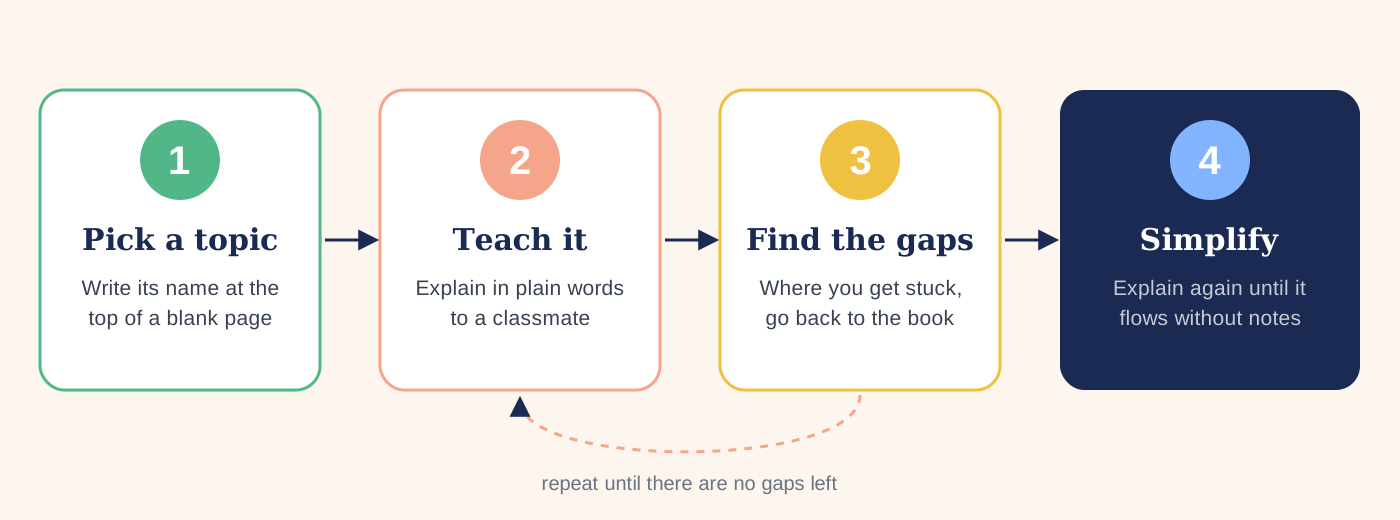
Step 1: Pick a topic
Write the name of one concept at the top of a blank page. Keep it small. "Electricity" is too big. "Ohm's law" is just right.
Step 2: Teach it in plain words
Explain the concept as if you were teaching a classmate who has never seen it. Use simple language, short sentences and at least one example. Saying it out loud works better than only writing it, and teaching a real person works best of all.
Step 3: Find the gaps
You will get stuck. Maybe you can't say why something happens, or you fall back on a textbook phrase you can't unpack. Those moments are the whole point. Mark them, then go back to the book for those parts only.
Step 4: Simplify and explain again
Explain the topic again, this time without notes. Replace jargon with everyday words and use an analogy if it helps. Repeat until the explanation flows from start to finish.
A worked example: Ohm's law (Class 10)
Here is how a first attempt and a final attempt might look.
First try: "Ohm's law says V equals IR. Voltage is current times resistance."
That is just the formula said aloud. A classmate asks, "But what does resistance actually do?" and the explanation stops. That is a gap.
After filling the gap: "Think of current as water flowing through a pipe. Voltage is the push from the pump. Resistance is how narrow the pipe is. A narrower pipe lets less water through for the same push. So if resistance goes up and voltage stays the same, current goes down. That's why V = IR."
Same formula, but now the student understands it and could solve a question they have never seen before.
Why it works better than re-reading
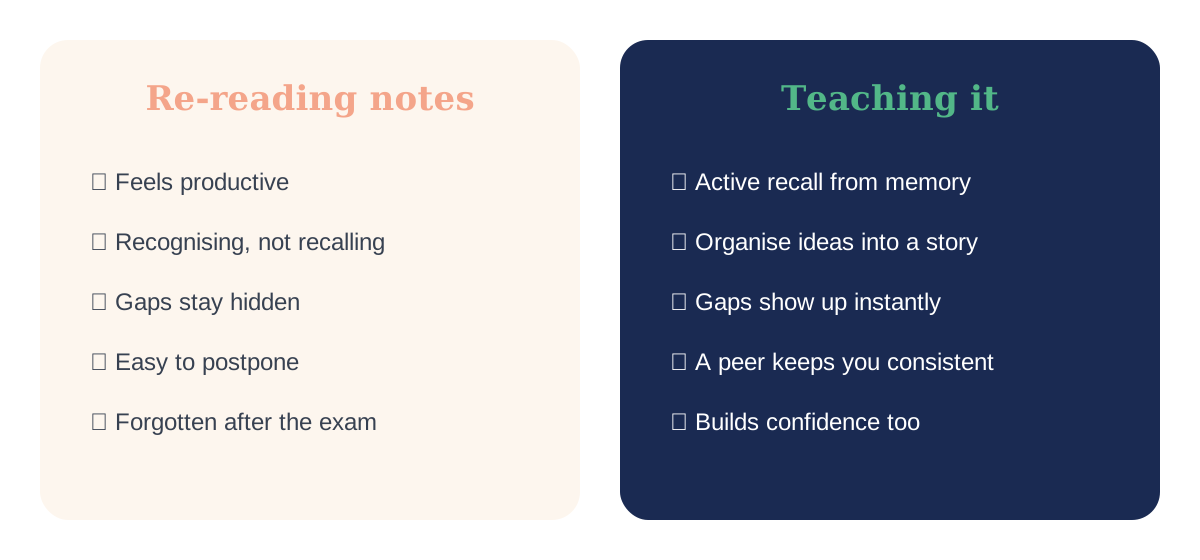
Re-reading feels productive because the page looks familiar. But recognising something is not the same as being able to recall and use it. Teaching forces active recall, makes you organise ideas into a story, and exposes gaps right away. This is also why learning by teaching is so effective.
Using the Feynman Technique with a study partner
The technique is powerful alone, but it is even better with a listener who asks questions. That is the idea behind peer teaching:
- Split a chapter into small sub-topics.
- Each of you prepares a few sub-topics to teach.
- Take turns teaching for 20 minutes while the listener asks "why?" and "what if?"
- Note every question you couldn't answer, and fill those gaps the same day.
| Doing it alone | Doing it with a partner |
|---|---|
| You decide when you are "done" | A listener's questions show what you missed |
| Easy to skip a day | Someone is waiting for your session |
| Explaining to an empty room | Real conversation builds confidence |
Quick tips
- Keep topics small. One concept per session.
- Ban textbook phrases. If you couldn't say it to a 12-year-old, simplify it.
- Draw it. Diagrams often explain more than paragraphs, especially in science and maths.
- Do it regularly. One short session a day beats a long session before the exam.
Try the Feynman Technique with Feynlearn
Feynlearn builds the Feynman Technique into your routine. Each chapter is split into sub-topics, a 20-minute teach-to-peer session is scheduled for each one, and a student moderator asks the doubts that reveal your gaps. A daily quiz with detailed solutions follows.
The pilot is open to Class 9 & 10 students in Pune. Join the pilot.
Learn by teaching with Feynlearn
20-minute teach-to-peer Feynman sessions, smart study plans and daily quizzes for Class 9 & 10 students.
Join the Pilot